
History
St Andrew’s Church in West Tarring stands as a remarkable witness to over a thousand years of English history, rooted in a landscape shaped by faith, community, and continuity. Its story begins even before the present building was raised: in AD 939, King Athelstan granted the manor of Tarring to Christ Church, Canterbury, establishing an early spiritual foundation for the area. By the time of the Domesday Book in 1086, a church—likely a simple wooden structure—already stood on this site. From its earliest days, St Andrew’s held a distinctive status as a “peculier” of the Archbishop of Canterbury, placing it under direct archiepiscopal authority rather than the local diocese, a mark of its importance and connection to the wider Church.
Throughout the medieval period, the church became intertwined with notable figures and events. In the mid-13th century, it offered sanctuary to Richard of Wych, later known as St Richard of Chichester, who had been barred from his own episcopal residence by King Henry III. During his time in Tarring, Richard ministered widely across Sussex and was reputed to have performed miracles, adding a spiritual legacy that still echoes in the church’s history. By the 16th century, St Andrew’s also reflected the more communal and lively aspects of parish life, hosting “church ales”—spirited gatherings where food, drink, and entertainment were used to raise funds for the church’s upkeep.
The centuries that followed brought both unusual and intriguing chapters. In the 18th and early 19th centuries, the churchyard became associated with local smuggling activities, with contraband reportedly hidden among its tombs by figures such as William Cowerson, who was himself employed in restoration work. Around the same time, the Henty family—later pioneers in Australia—departed Tarring, taking with them the church’s medieval font, which now resides in a cathedral in Melbourne. The church also shares a connection with the renowned jurist John Selden, who was baptised here in 1584 and is commemorated within its walls.
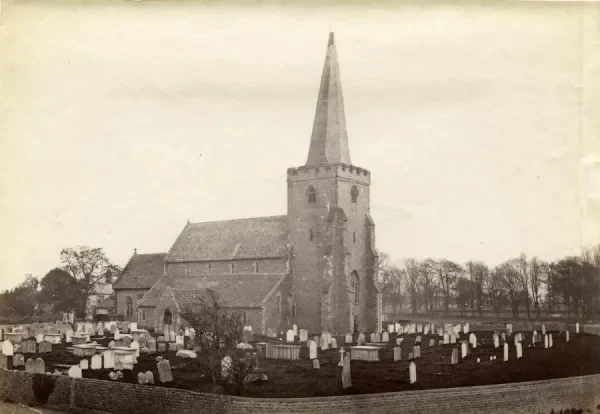
Architecturally, St Andrew’s reflects centuries of careful development and adaptation. The present building is largely Early English Gothic, with a 13th-century nave that still survives today. The 15th century saw the rebuilding of the chancel and tower in the Perpendicular Gothic style, followed in the 16th century by the addition of the distinctive octagonal spire that remains a local landmark. In the 19th century, the church entered a new phase, joining the Diocese of Chichester in 1845 and undergoing significant restoration in 1853, including the installation of mosaics depicting the Twelve Apostles.
Beyond its structure, St Andrew’s has long served as a spiritual home for the surrounding community. When nearby churches in Durrington and Heene fell into ruin in the 17th century, their parishioners were welcomed here, reinforcing its role as a centre of worship and fellowship.
Today, as a listed building of significant historical and architectural interest, St Andrew’s continues to stand at the heart of West Tarring—an enduring place of prayer, heritage, and community life.
Check out the web links below to find out more about both the church and the locality.
British History Online - provides a detailed history of the village of West Tarring, its economic growth through the centuries and the key buildings, including St Andrew's Church and the Archbishop's Palace.
Sussex Parish Churches - provides a detailed description of the church, with photographs.
Historic England - provides the formalised description of St Andrew's as a Grade II-listed building.
Gravestone Photographic Resource - contains an entry and some information on the church graveyard.
In Wikipedia, you can find entries for St Andrew's Church, the village of West Tarring, John Selden (one of West Tarring's most famous inhabitants), the poet laureate Robert Southey (father-in-law of one of the 19th-century rectors and who has a window dedicated to him), St Richard of Chichester (who is supposed to have visited the village in the 13th century and who also has a window dedicated to him) and numerous links to other sources of information.
Are you visiting Tarring, want to learn a bit of its history and follow a good walking root? Have a look at Tarring Trail.