
The Mosaics
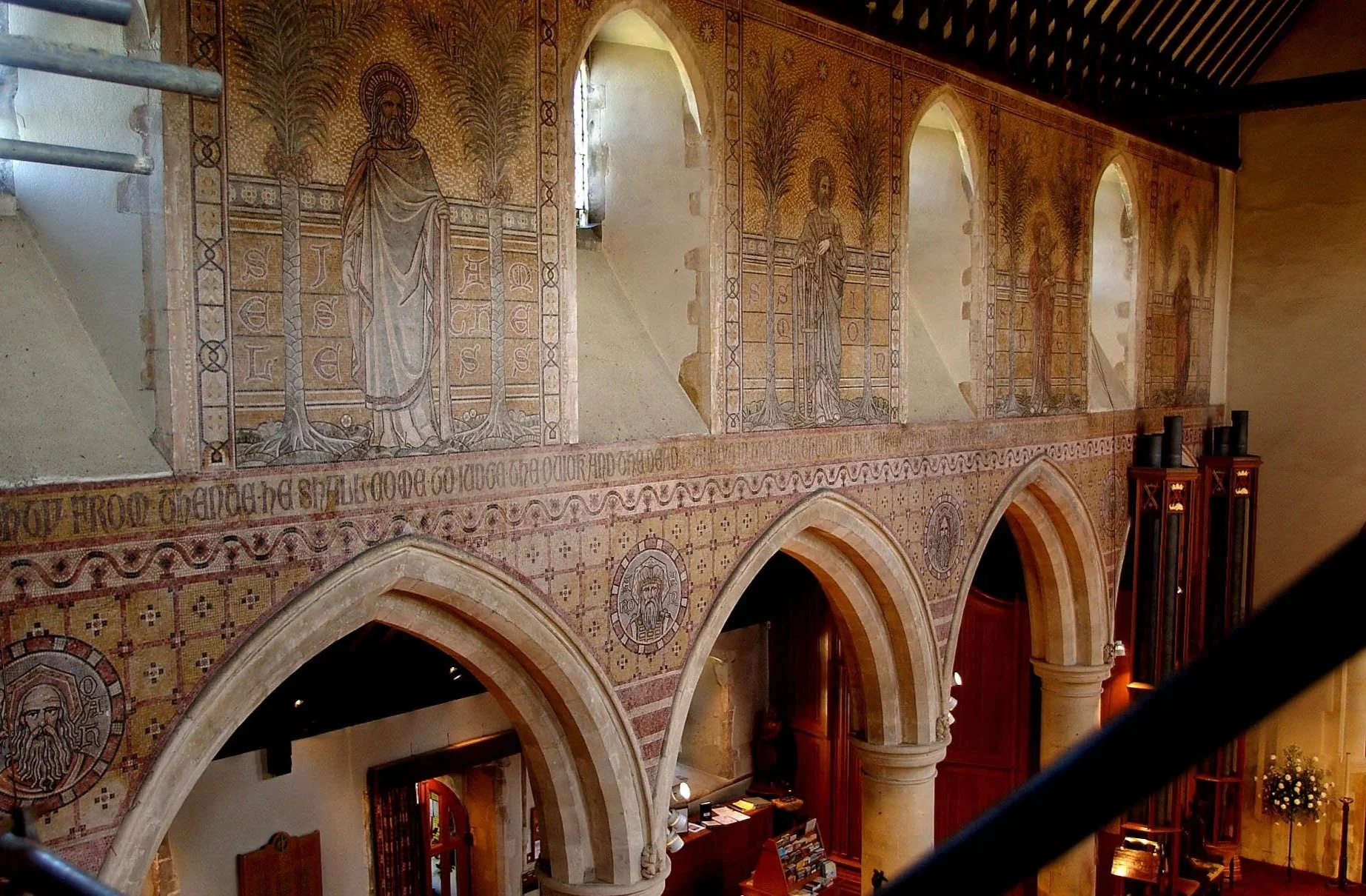
Over 200 square metres of marble mosaics cover the interior walls of the north, south and west sides of St Andrew's Church. They were designed by the Victorian architect William Butterfield FSA (1814-1900). Believed to be based on mosaics he had seen in the Basilica at Ravenna, they were constructed by Italian craftsmen in 1884 and 1885.
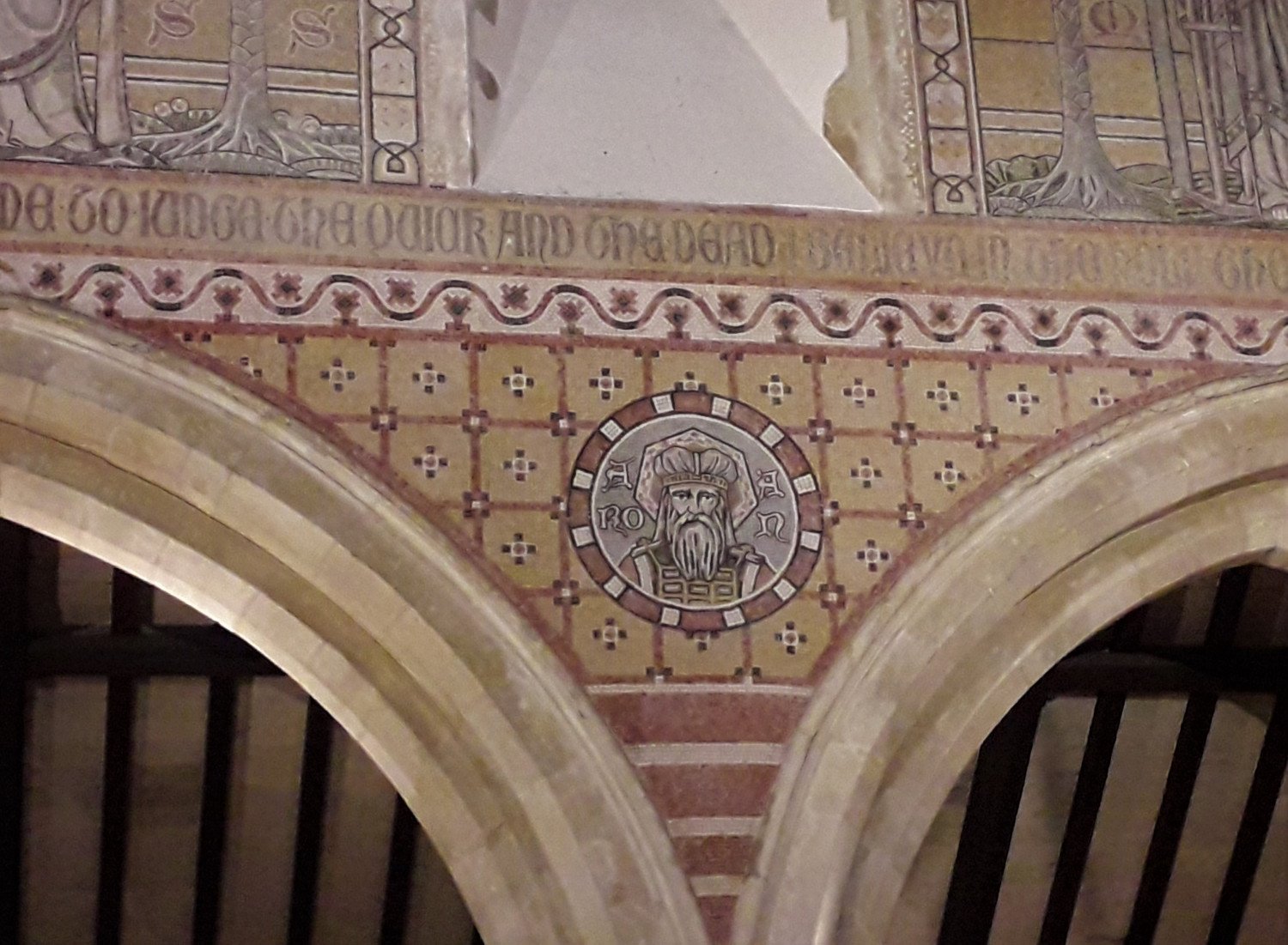
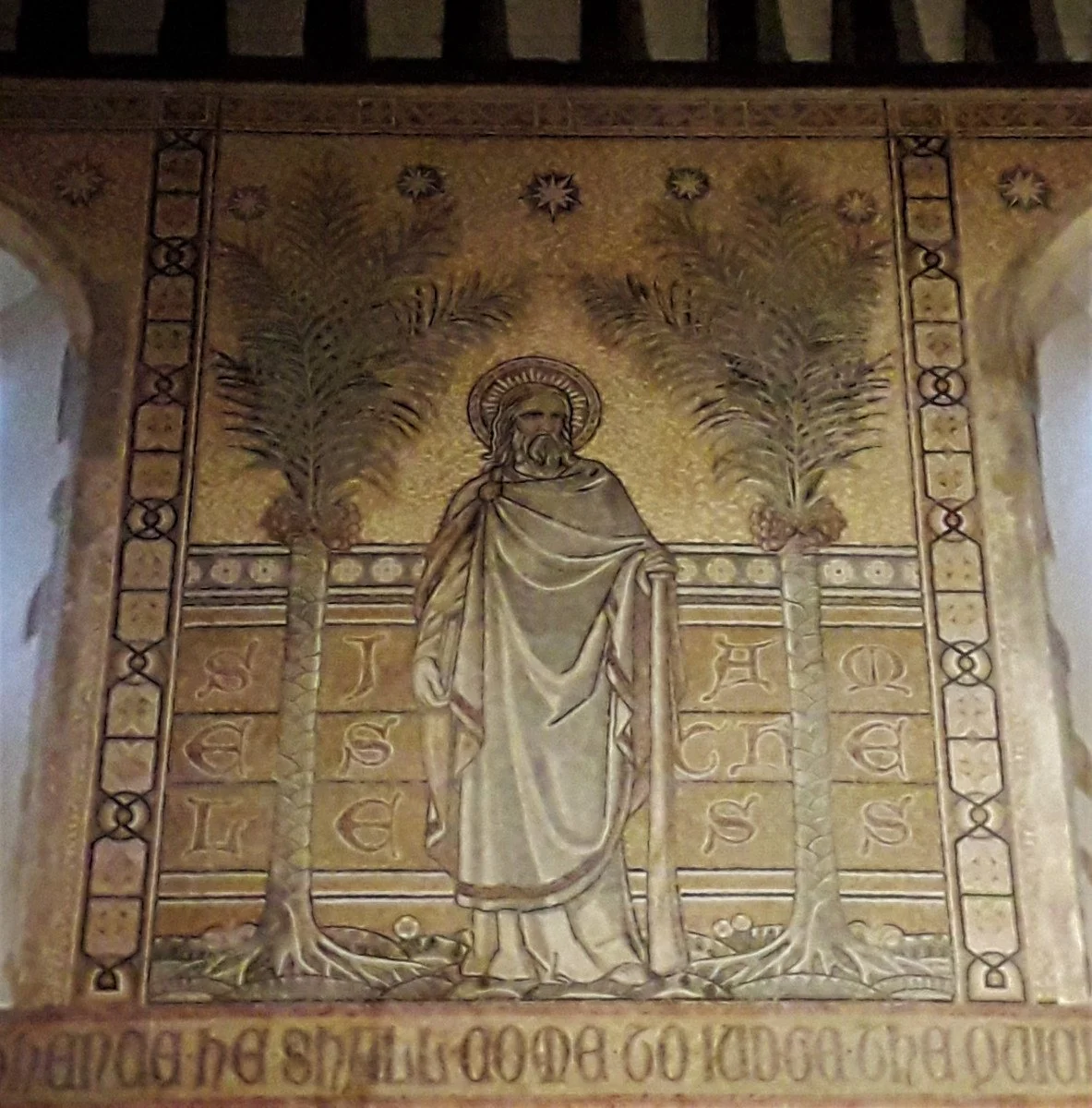
Based on the notion that the Early English nave is a ‘twelve-apostle-arch’ construction, the two-tiered mosaics depict the twelve apostles, supported in the lower tier by medallions portraying the Patriarchs of Israel. The two tiers are divided by a band, which contains the text of the Apostles Creed. Each apostle figure is 1.8 metres high, and stands within a panel measuring 3.5 metres by 2.75 metres. The panels are decorated with fruiting palms and stars. Each apostle is identified not only by name, but also by those emblems traditionally associated with him.
The driving force behind the decoration of the church with mosaics was the Rev. Henry Bailey. DD who succeeded the Rev. John Wood Warter - the rector who had instigated a major restoration of the church in the mid 1800s. The Rev. Bailey's reasoning is explained in his booklet An Argument for the Decoration of Churches, which contains much information about the designs.
The symbols depicted in the mosaic panels were described in the St Andrew's Parish Magazine from September 1885. Here is an extract...
"The general design of the pictures is to remind us of the ministry of God's servants in proclaiming His Word: the patriarchs and prophets by the dispensation of the Law: and the twelve apostles by the preaching of the Gospel. The figure of each prophet or apostle is marked by some emblem which reminds us of his character or his work.
ISAIAH wears the mantle, which we are told is the dress of the prophets.
ELIJAH also has the mantle, but it is of camel's hair, to remind us of his sojourning in the Arabian wilderness.
ABRAHAM has the head-dress of the chief of a wandering tribe, which is very much the same now as in the days of Abraham.
ENOCH is represented as a very old man, as he attained the age of 365 years (Gen v,. 23)
NOAH has the dove perched on his shoulder.
AARON has the mitre and the breastplate of twelve stones, which formed part of the robes of the high priest.
MOSES has the tablets of the law, and the horns which were the emblems of authority and power (Psalm cxii, 9).
DAVID bears the crown and sceptre, which shows that he became King of Israel.
Thus we are reminded of the history of three patriarchs, two preachers, a high priest, a lawgiver and a psalmist, each of whom was, in the fullest sense of the word, a prophet of God under the Old Testament dispensation.
Among the Apostles:
PETER has the keys, reminding us our Lord's words to him recorded in St Matthew xvi, 19.
ANDREW has the cross, on which historians tell us how he was crucified.
JAMES the son of Zebedee has the staff of a pilgrim, because he was the first to journey through the death of martyrdom to the 'land which is very far off'.
JOHN has the silver cup, reminding us how he sat by our Lord at the Passover supper: and also that in his case, according to certain historians, there was fulfilled our Lord's promise Mark xvi, 18.
PHILIP has a basket of fish, as he was present at the miracle of the loaves and fishes.
BARTHOLOMEW has a book of the Gospels from which he preached, and the knife by which he was martyred by the heathens in Armenia.
THOMAS carries the mathematical instrument called a square, because he had an exact, closely reasoning mind, declining to believe what he had not seen for himself.
MATTHEW has the book of the Gospels, of which he was the first writer.
JAMES son of ALPHEUS has the club by which he was slain.
SIMON ZELOTES has the saw, the emblem of the carpenter's occupation, and also the instrument of his martyrdom.
JUDE has a boat reminding us how many apostles were constantly employed on the Lake of Galilee.
MATTHIAS has a book of the Gospels, which he preached, and the spear by which he was martyred in Ethiopia.
We notice in each case, that we are reminded either of the Apostle's character, or his occupation, or his work for Christ, or death in the Master's service. The pictures, as a whole, point out how, by men of very different character and occupation, our Lord may be equally glorified, if life and death be devoted to Him."
The Emblems and Symbols
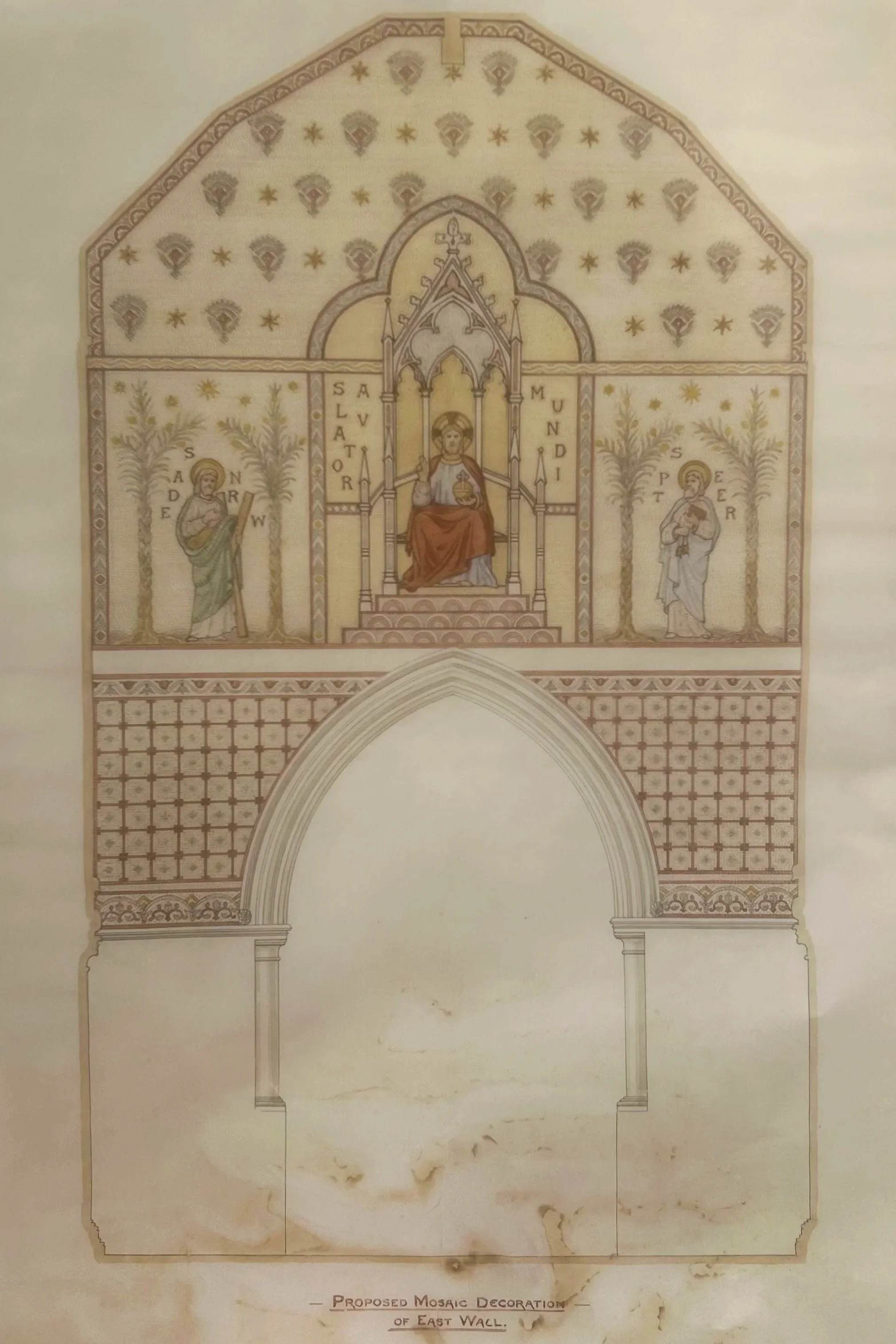
In William Butterfield's original design, the mosaics included a large panel above and around the arch to the chancel, which depicted Christ in Glory, flanked by St Peter and St Andrew. It was, however, never completed due to lack of funds.
Later, in both the 1930s and 1990s, investigations were undertaken to determine the feasibility of completing Butterfield's design, but, in neither instance did funds allow; hence, today, this wall is simply painted white.
The drawing here is what the architect envisaged.
The Unfinished Wall
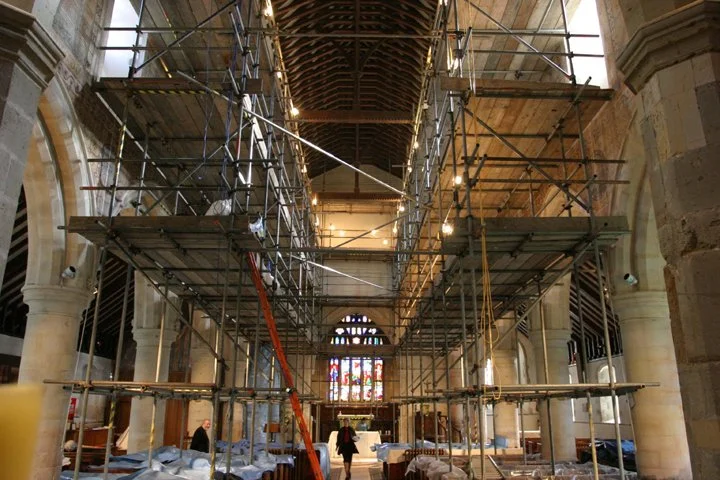
The mosaics were first professionally cleaned in 1930, some 45 years after their installation. By the 1990s, however, they were showing signs of neglect. Expert surveys identified that large areas had become discoloured and that in certain places the substrate was decaying.
Given their cultural signifiance to the nation, the then PCC set up a sub-committee (under the chair of Veronica Donkin) in 1998 to investigate possible solutions and costs. The final decision was to take measures to 'conserve', rather than 'restore', the mosaics - at a cost of £50,000.
The work took expert conservationists several months to complete, the scaffolding finally coming down in early 2006.